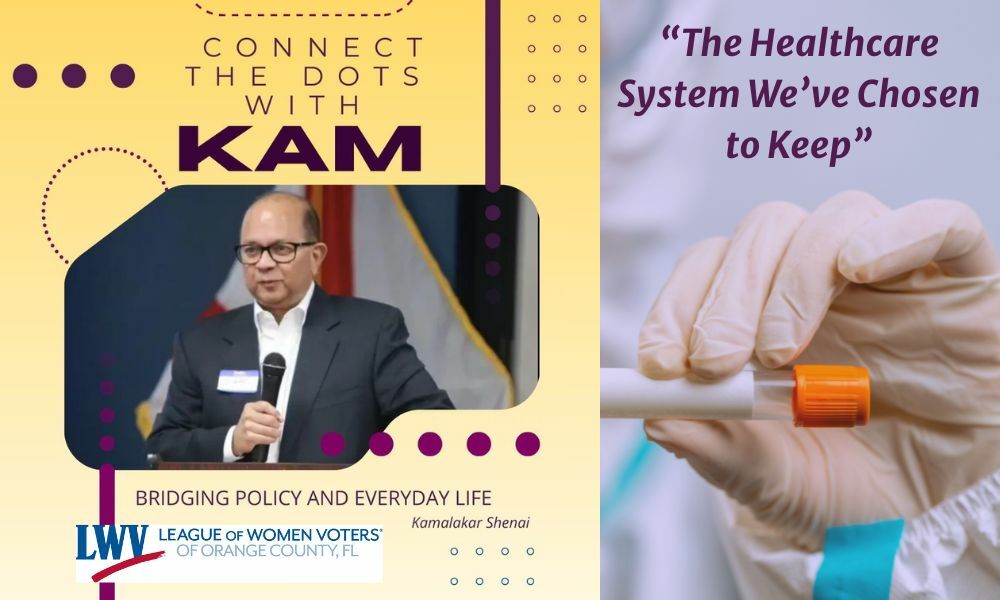
The Healthcare System We’ve Chosen to Keep
By Kam Shenai
Recently, I took an Uber in Washington, D.C. and struck up a conversation with the driver. After the usual small talk, he turned serious, asking about healthcare — insurance, drug prices, access.
I tried to explain how the system works.
He listened carefully and finally said: “I still don’t get it.”
He is not alone.
The United States now spends roughly $5 trillion a year on healthcare — nearly 18% of our gross domestic product. No other nation spends this much. Yet many Americans struggle with premiums, deductibles, and prescription costs.
How did we arrive here?
Consolidations Changed The Marketplace
Over the past two decades, healthcare has consolidated dramatically.
CVS Health owns an insurance company (Aetna), a pharmacy benefit manager (PBM), thousands of retail pharmacies, and walk-in clinics. Roughly one in three prescriptions in the United States flows through its PBM.
UnitedHealth Group insures millions of Americans and operates one of the nation’s largest pharmacy benefit managers and physician networks.
Supporters argue that this type of vertical integration improves coordination and efficiency. Critics contend it can reduce competition and make pricing less transparent. What is clear is that market concentration has increased significantly – and it did so gradually, with bipartisan regulatory approval over time.
Why Prices Feel Opaque
Imagine buying a car from a dealer who also owns the bank issuing your loan, the mechanic inspecting the vehicle, the insurance company covering it, and the gas stations you’ll use for years.
At every step, the same company profits.
Healthcare financing, pricing, and delivery often operate within similarly intertwined structures. That makes it difficult for consumers to see where dollars flow and whether prices reflect true market competition.
The Numbers Matter
Healthcare now exceeds total national spending on education and is several times defense funding. It continues to grow faster than many other sectors of the economy.
Research published in major medical journals suggests that hundreds of billions of dollars annually may be associated with administrative complexity, pricing inefficiencies, unnecessary services, and lack of coordination. Even modest percentage improvements would translate into enormous savings.
Healthcare also consistently ranks among the highest spending sectors in federal lobbying. That activity is legal and part of our political system. It also means reform debates often include well-resourced stakeholders with significant influence.
If current projections hold, healthcare could exceed 20% of GDP within the next decade. That does not signal imminent collapse. It signals trade-offs.
Every additional dollar devoted to healthcare is a dollar unavailable for education, infrastructure, research, or deficit reduction. Those opportunity costs shape our national priorities.
Why Reform Is Difficult
Healthcare touches every American and involves insurers, hospitals, physicians, pharmaceutical companies, employers, and both federal and state governments. Every policy shift has ripple effects.
When Medicare Part D was enacted in 2003, it prohibited federal negotiation of drug prices. Nearly twenty years later, Congress authorized limited negotiation on select drugs. That timeline illustrates how gradual structural reform can be in a system of this size.
Large systems change slowly, especially when so many interests are involved.
What Civic Engagement Requires
Meaningful reform will not emerge from one election or one bill. It requires sustained, informed civic engagement — the kind long modeled by the League of Women Voters.
Here are practical starting points:
- Educate widely. Learn how insurance, PBMs, provider networks, and reimbursement systems function — and share that understanding in community forums and discussions.
- Ask focused questions. Encourage candidates to explain how their proposals would improve transparency, competition, affordability, or patient outcomes.
- Share real experiences. Stories of delayed approvals, confusing bills, or unexpected costs help humanize abstract policy debates.
- Teach the next generation. Help younger citizens understand both the mechanics of the system and the importance of sustained civic participation.
This is not a call for outrage. It is a call for persistence. This fight mirrors historic movements: women’s suffrage (70+ years), civil rights, labor rights, marriage equality—all demanded decades of persistent civic engagement.
The Choice Before Us
My Uber driver wanted clarity. So do millions of Americans.
A $5.3 trillion system should not be beyond the understanding of the citizens who finance it.
We may disagree on specific solutions. Some will emphasize competition and market forces. Others will emphasize regulation and oversight. But we should be able to agree that transparency, accountability, and informed debates are essential.
Reform will not be fast. Large systems rarely change quickly. But history shows that sustained, informed civic engagement can reshape even the most entrenched institutions.
If we remain engaged — calmly, persistently, and across election cycles — we can improve the system our children and grandchildren will inherit.
That is not partisan.
That is citizenship.
-----
Kam Shenai is Co-Founder of AAPI Coming Together (ACT Florida). He holds an MS from UC Berkeley and an MBA from RIT. Previously VP Marketing Operations Xerox North America and CCO at Sutherland Global Services; he currently serves as Chair of the Myrtle Creek District Board and on the Board of Trustees for UCF Lake Nona Hospital. He is a patient advocate with the National Kidney Foundation. Kam is also a member of the League of Women Voters of Orange County.