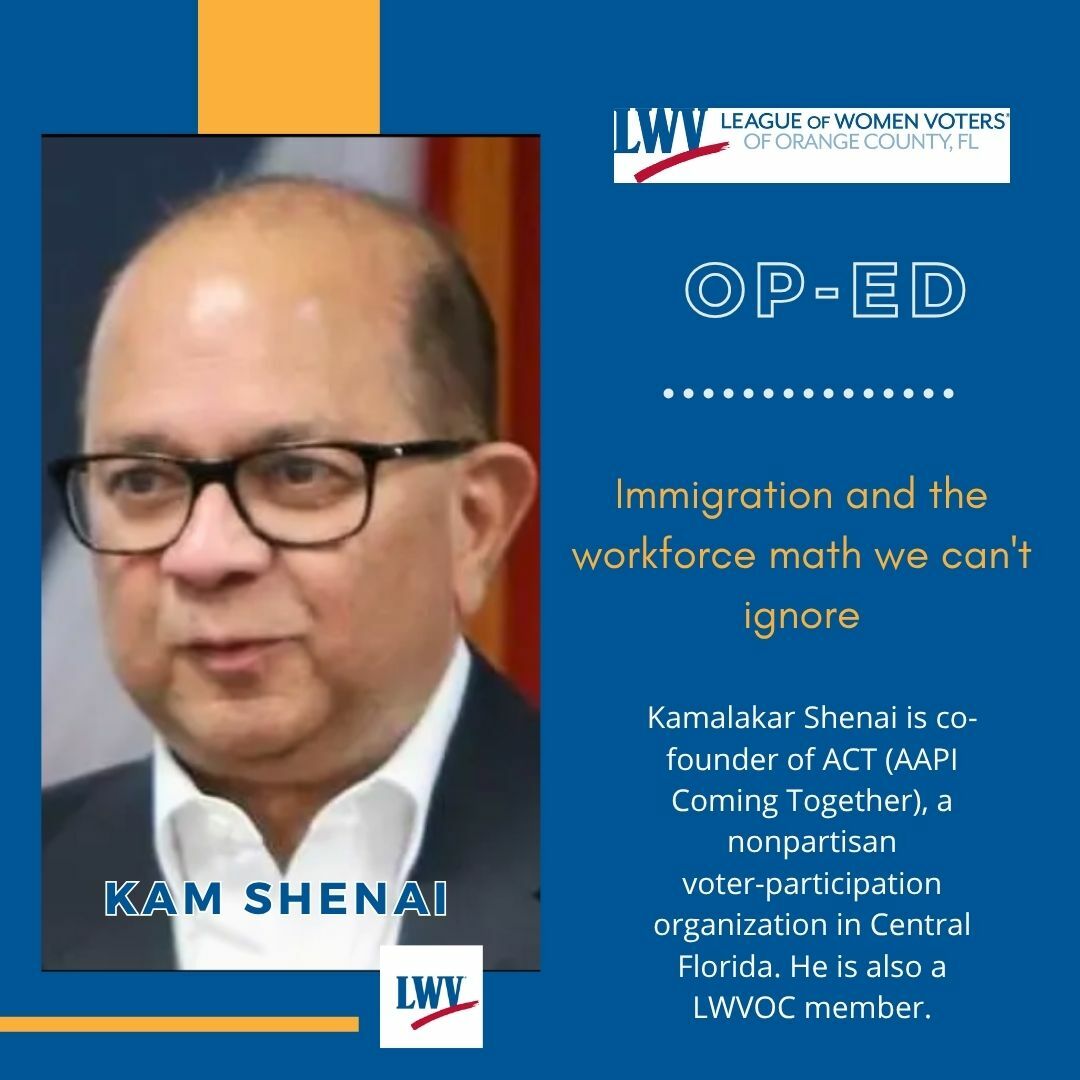
Commentary: Immigration and the workforce math we can't ignore
By Kam Shenai
PUBLISHED in Orlando Sentinel: April 10, 2026, at 5:30 AM ET
Across Central Florida, businesses are struggling to find workers. Construction sites are short-handed. Hospitals are stretched. Service jobs go unfilled. This is not just a local problem.
And yet our immigration debate rarely starts there.
Fifty years ago last month, I arrived in the United States with $208 in my pocket. I went through the legal immigration process. I built a life here. I know what this country asks of immigrants. And I know what immigrants give back.
So let me share the part of this debate that gets left out: The workforce math.
The U.S. economy runs on about 168 million workers and produces roughly $29 trillion a year in gross domestic product. Nearly one in five of those workers is foreign-born. Remove them, and you do not have the same economy. You have a smaller one.
That is not a political opinion. It is arithmetic.
The American-born workforce is barely growing. Birth rates are down. Baby boomers are retiring at roughly 10,000 per day. Fewer workers are entering the labor force than leaving it. We already face shortages of 135,000 health care workers and 500,000 construction workers — and those gaps are widening.
Immigrant workers are filling many of those gaps right now. Nearly 30% of construction workers are immigrants. One in six nurses. One in four nurses’ aides. More than a quarter of farm workers. These are not optional jobs. They are the jobs that keep the lights on.
In 2023, undocumented immigrants alone paid nearly $90 billion in federal, state, and local taxes. That includes $26 billion into Social Security and $6 billion into Medicare — programs they are not allowed to collect from. Ever.
Read that again. They pay in. They never take out.
And yet much of today’s debate moves toward reducing the number of immigrant workers — without explaining where the replacements will come from.
You cannot promise a growing economy while shrinking the workforce that runs it. Those two things cannot both be true.
The border matters. And so does the system behind it. Right now, courts are backlogged for years. There are not enough judges or caseworkers. Telling someone to come legally means nothing when the legal line barely moves.
I know this firsthand. The H-1B backlog for skilled workers from India can stretch longer than a human lifetime. Family petitions can take 20 to 30 years. Miss one deadline and you can lose everything — even after doing everything right.
A locked door with no legal window does not stop people. It just makes everything more dangerous and chaotic.
So, what does a serious approach look like?
Secure the border — but with enough staff to actually process people, not just turn them away. Fix the courts, update the visa programs, and create an earned path for the millions already here who have played by the rules.
America has a worker shortage. The only question is whether we are willing to deal with it honestly.
I have been here 50 years. This country gave me everything. It works best when the math adds up.
Right now, it does not.
Kamalakar (Kam) Shenai is co-founder of ACT (AAPI Coming Together), a nonpartisan voter-participation organization in Central Florida.
© 2026 Orlando Sentinel